RESEARCH
Browse our database and discover research projects around vocal improvisation in the Renaissance

Counterpoint models : our database
SuperLibrum is not responsible for the artistic choices made in the audio links
Bibliography
HISTORICAL SOURCES

CONTEMPORARY SOURCES

Bibliography of studies on the ‘improvised’ dimension of counterpoint, both vocal and instrumental (by P. Canguilhem)
Bibliography of studies on the ‘improvised’ dimension of counterpoint, both vocal and instrumental (by P. Canguilhem)
External ressources

Modern transcription of musical examples taken from Vicente Lusitano’s treatises on the CESR website.

Partner projects
STUDY DAYS IN GENEVA 2025

Discover the lectures at the study days « The Renaissance of counterpoint » in October 2025 at the HEM in Geneva.
Basse danse research project
In collaboration with the HEM in Geneva - Project directed by Patricia Esteban
How did musicians improvise polyphony to accompany Renaissance court dances? This project reconstructs that lost art, drawing on the tenors and choreographies preserved in basse danse manuscripts.
Spanning musical and choreographic sources from 1470–1600, the research focuses especially on the Brussels manuscript (ms. 9085) which is preserving the central tenor part, missing from other dance collections.
The core challenge lies in the ever-changing step sequences dancers had to memorize. A team of early-dance and music specialists (flute, tambourine, and more) will explore how music and choreography intertwined and what that reveals about the Renaissance dance master's craft.
The project will create two inventories: the first one of contrapuntal patterns from the tenors, and the second one of rhythmic patterns supporting specific steps. These will form the basis of a teaching tool for movement-based musical improvisation in the late 15th-century repertoire.
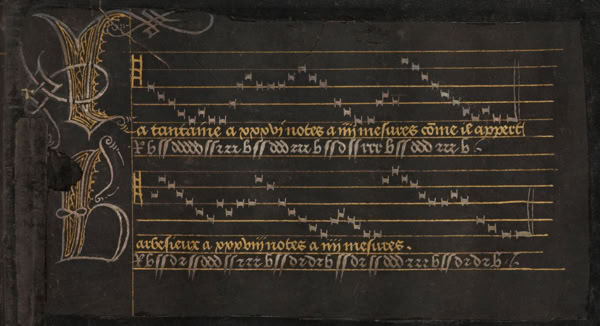
An excerpt of ms. 9085 commonly referred to as Margaret of Austria’s basse danse manuscript
RECANTUS - recording cantus firmi
In collaboration with the HEM in Geneva - Project directed by Antoine Schneider
How do you pass on a craft born from singing and collective practice, when students find themselves alone at their music stand? This project builds on a broader revival of Renaissance vocal improvisation.
Teaching counterpoint through sung improvisation rather than theory alone grounds students in a living and embodied practice. However this pedagogy relies on collective singing and can be hard to replicate alone outside of class.
RECANTUS addresses this by creating a series of model melody recordings (cantus firmus), organized by level and tempo, letting students improvise solo while embedded in an existing polyphony. Released under an open license, these resources will reach beyond the classroom to a wider community of musicians interested in early improvisation.
Beyond the tool itself, the project aims to sharpen students' polyphonic listening, intonation, and aural memory, testing a hybrid learning model for a discipline that has historically been oral and collective.